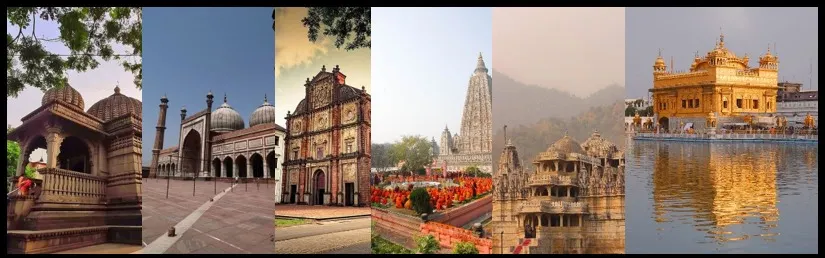
History of Diversity in India
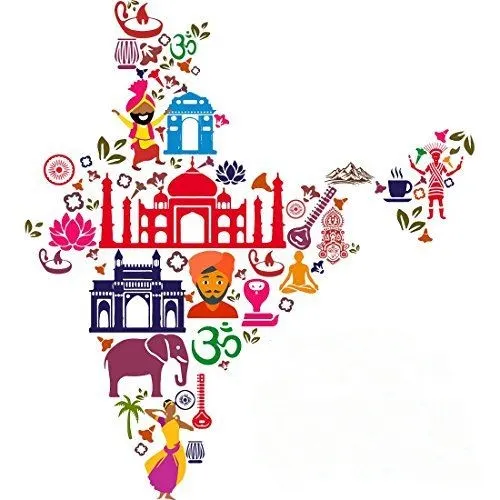
India's unity in diversity
Cultural diversity in India is the result of several factors operating over a vast span of time:
Philosophical differences within (e.g. Shivas & Vaishnavas in Hindus or Digambar & Svetambara in Jains) & amongst (e.g. Hindus, Buddhists, Jains, Sikhs, etc.) the religions that were established here,
Migration (e.g. Zoroastrianism) and
Foreign Invasions (e.g. Islam & Christianity)
The second and third factors are relatively well known. However, the first factor is less understood and deserves closer examination.
Philosophical differences amongst the religions that were established in India
The Vedas (Orally transmitted since the times unknown and written anywhere between 1500–500 BCE) consisting of Samhitas, Brahmana, Aranyaka & Upanishads are considered as the prime source of Hindu philosophy. Keeping the mythological story about their origin aside, we find that they are compilation of verses framed by many authors who existed at different points of time. Thus, we see that Vedas evolved with the passage of time, they went through a rigorous process of refinement at the hands of sages who kept contributing basis their wisdom.
However, after a point of time the process of refinement stopped and Vedas (as we see them today) were formed. Their supremacy was established and thus the scholars of this era devoted themselves into Interpreting them which subsequently led to the formation of different schools of thoughts whose teachings spread across different regions. If a particular school got recognition from the King, that school would become dominant in that kingdom, thus we can see that a particular school of thought (who’s beliefs and practices are now the culture of that region) is more dominant in few parts than in the other parts of the country.
Establishment of Buddhism (sometime time around 5th Century BCE) was the result of the same process except for Gautam Buddha didn’t agree about the supremacy of Vedas but accepted few principles stated in them.
Thus, we can see how different interpretation of Vedas led to cultural diversity within Hinduism & how differences of opinion led to the formation of new religions. The Geographical Factors, Migration & Foreign Invasions further added to the diversity that already existed.
The Secret of Unity

Khadi, a symbol of unity
Unity comes from understanding the fact that majority of the diversity in India is in fact the branches of the same tree. Religious tolerance further welcomed the diversity that was brought in by migration & Invasions.
Though India was fragmented into various kingdoms before British raj was established (in 1858) its people always had a sense of Nationalism which is evident by the establishment of Vijayanagar Empire (1336–1646) in the Southern Part of India during the period of Tughluq Dynasty (1320–1413) and Maratha Empire (1674–1818) in the State of Maharashtra during the period of Mughal Empire (1526–1858).
The growing need to formally unite this subcontinent under one name was increasingly felt because of exploitation of the resources caused by the British raj unlike Mughals or Tughluqs who came and settled here. We will call this process as ‘Formal Unification Process’ which involved weaving together of the Intricate Social fabric of India.
Hence, we can see that the formal unification process began at pan India level in 1857 when Tatya Tope, Rani Laxmibai, Bakht Khan and others led the armed struggle against the British Raj. Many people argue that their efforts were to restore the structure that existed before the Britishers took over, but it had a National Character in the sense that they were united and fighting to overthrow a power that they considered to be foreign whilst keeping in mind the greater good of their motherland! This event was named as ‘The Indian Rebellion of 1857’ which was later renamed as ‘1857, India’s first War of Independence’ by V.D. Savarkar. The war ended with the Britishers nearly escaping the end of their rule in the subcontinent and the baton of freedom struggle passing into the hands of moderate leaders.
Moderate leaders like Dadabhai Naoroji, Justice Ranade and others did the work of laying the foundation for the social fabric by enlightening the minds of Indians with social reforms, theories, etc. India was a Nation under making during this period.
Then came the era of extremist leaders like Bal Gangadhar Tilak who fought for freedom of press and education. The enlightenment and a sense of unity that was brought in by the Moderates & Extremists saw its public outpour when Tilak was deported to Mandalay. The entire Nation cried!
After Tilak, Gandhiji was looked upon as the leader and during his period the youth was ignited, educated and most importantly united with a determination to end foreign rule. In the last few years of the British raj the independence was almost certain but there was a political deadlock in India due to Muhammad Ali Jinnah demanding a separate Nation for Muslim minority siting the threat of oppression by the majority Hindus. It made little sense as both the religions coexisted since long but the sense of insecurity was so high that Jinnah along with his followers parted their ways with India. Despite these happenings the rest of the India remained united.
This brought an end to the prolong freedom struggle and the resultant Nation that came into existence had a unique social fabric that holds it together till date whilst keeping alive its diversity!